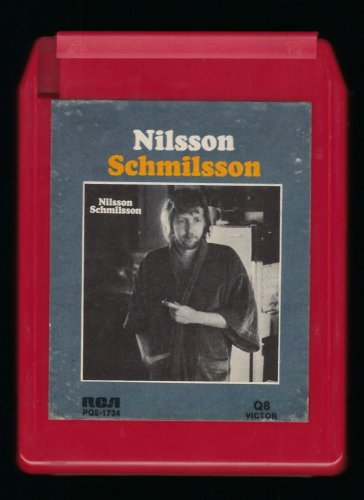
Nilsson Schmilsson is the seventh studio album by American singer Harry Nilsson, released by RCA Records on November 11, 1971. It was Nilsson's most commercially successful work, producing three of his best-known songs. Among these was the number 1 hit "Without You", written by Pete Ham and Tom Evans of the group Badfinger. The album was the first of two Nilsson albums recorded in London and produced by Richard Perry.
"Jump into the Fire" and "Coconut", both written by Nilsson, also became hits. The album performed well at the 1973 Grammy Awards, earning a nomination for Album of the Year, while "Without You" won the Grammy for Best Male Pop Vocal Performance. In 2006, Nilsson Schmilsson was ranked number 84 on Pitchfork's "Top 100 Albums of the 1970s". The album was ranked #281 in the 2020 revision of Rolling Stone's 500 Greatest Albums of All Time list.
Harry Edward Nilsson III (June 15, 1941 – January 15, 1994), sometimes credited as Nilsson, was an American singer-songwriter who reached the peak of his success in the early 1970s. His work is characterized by pioneering vocal overdub experiments, a return to the Great American Songbook, and fusions of Caribbean sounds. Nilsson was one of the few major pop-rock recording artists to achieve significant commercial success without performing major public concerts or touring regularly.
Born in Brooklyn, Nilsson moved to Los Angeles as a teenager to escape his family's poor financial situation. While working as a computer programmer at a bank, he grew interested in musical composition and close-harmony singing and was successful in having some of his songs recorded by various artists, such as the Monkees. In 1967, he debuted on RCA Victor with the LP Pandemonium Shadow Show, followed by a variety of releases that included a collaboration with Randy Newman (Nilsson Sings Newman, 1970) and the original children's story The Point! (1971).
He created the first remix album, Aerial Pandemonium Ballet, in 1971, and recorded the first mashup song ("You Can't Do That") in 1967. His most commercially successful album, Nilsson Schmilsson (1971), produced the international top 10 singles "Without You" and "Coconut". His other top 10 hit, a cover of Fred Neil's "Everybody's Talkin'" (1968), was featured prominently in the 1969 film Midnight Cowboy. A cover of Nilsson's "One", released by Three Dog Night in 1969, also reached the U.S. top 10.
During a 1968 press conference, the Beatles were asked what their favorite American group was and answered "Nilsson". Sometimes called "the American Beatle", he soon formed close friendships with John Lennon and Ringo Starr. In the 1970s, Nilsson and Lennon were members of the Hollywood Vampires drinking club, embroiling themselves in a number of widely publicized, alcohol-fueled incidents. He and Lennon produced one collaborative album, Pussy Cats (1974). After 1977, Nilsson left RCA, and his record output diminished. In response to Lennon's 1980 murder, he took a hiatus from the music industry to campaign for gun control. For the rest of his life, he recorded only sporadically. In 1994, Nilsson died of a heart attack while in the midst of recording what became his last album, Losst and Founnd (2019).
The craft of Nilsson's songs and the defiant attitude he projected remain touchstones for later generations of indie rock musicians. Nilsson was voted No. 62 in Rolling Stone's 2015 list of the "100 Greatest Songwriters of All Time", where he was described as "a pioneer of the Los Angeles studio sound" and "a crucial bridge" between 1960s psychedelia and the 1970s singer-songwriter era. The RIAA certified Nilsson Schmilsson and Son of Schmilsson (1972) as gold records, indicating over 500,000 units sold each. He earned two Grammy Awards (for "Everybody's Talkin'" and "Without You").
Retrieved from
https://en.wikipedia.org/wiki/Harry_Nilsson
T21
Comes to you fully restored, ready to play with a 7-day money back guarantee.